


Get latest update for our trusted applications
Get latest update for our trusted applications
Cognitive Marketing · Performance Marketing Insights · April 2026
To improve ROAS in India, you need to fix four layers simultaneously: accurate conversion tracking, landing page conversion rate, lead quality, and sales follow-through speed. Most businesses lose return on ad spend not inside their ad account but between the ad click and the revenue — in a broken WhatsApp follow-up, a homepage landing page, or a sales team that responds 6 hours too late.
This guide gives you the complete diagnostic framework and the 7-step system to fix it, with India-specific playbooks for D2C brands, healthcare, education, and real estate.
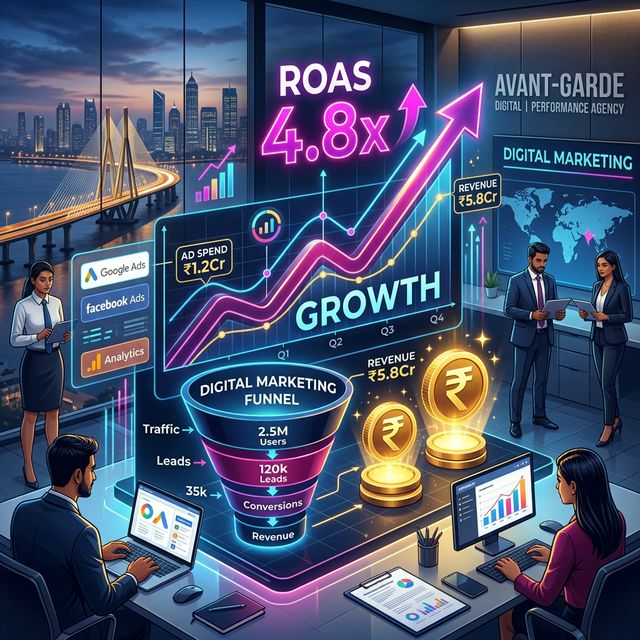
ROAS stands for Return on Ad Spend. The formula is deceptively simple:
ROAS = Revenue Generated ÷ Ad Spend
A ROAS of 4x means for every ₹1 you spend on ads, ₹4 in revenue comes back. A ROAS of 1x is breakeven. Below 1x, you're funding your competitors' growth.
But here's what most ROAS guides miss: what counts as "revenue" changes everything.
For a D2C brand, revenue is the completed purchase — trackable, immediate, attributable. For a real estate developer, a single converted lead might represent ₹60 lakh to ₹2 crore in deal value. For a healthcare clinic, it's appointment and procedure revenue. For a coaching institute, it's course enrolment. The point is that ROAS is only a meaningful number if you're measuring it against actual revenue — not proxies for revenue.
The majority of Indian businesses we audit are measuring ad spend vs leads generated, not ad spend vs revenue closed. That gives you a Cost Per Lead metric, not ROAS. Optimising for CPL is fine — but it will push your campaigns to generate more leads, not better leads, which is almost always the wrong outcome.
ROAS ignores the cost of goods, operations, fulfilment, and sales team salaries. A ₹5 ROAS on a product with a 15% gross margin is a business in trouble. What you actually want to track is MER (Marketing Efficiency Ratio) or true blended ROAS: total revenue across all channels divided by total ad spend. For most Indian businesses, this blended view — not campaign-level ROAS — is the number that tells you whether advertising is working.
You can follow a well-regarded international ROAS guide step by step, execute it correctly, and still see no improvement in India. That's not incompetence — it's market context. Here are the India-specific factors that generic playbooks ignore:
Understanding these pressures is the prerequisite for any ROAS improvement effort in India.
Before changing a bid strategy, rewriting ads, or restructuring campaigns, audit these five layers. Across our work with businesses in 23+ industries — from D2C apparel to hospital chains to coaching institutes — poor ROAS almost always traces back to one or more of these layers being broken.
Is your conversion data trustworthy? Common failures that produce misleading ROAS numbers:
Fix: Full GA4 audit, Tag Manager container review, and Google Ads conversion action mapping. Align every tracked event to an actual revenue milestone.
If your landing page converts at 1.5% and a competitor's converts at 4.5%, you need 3x more traffic — and 3x more budget — to generate the same number of leads. You cannot bid your way past a conversion rate gap. This is where the majority of Indian businesses are bleeding ROAS without realising it.
Key metrics to track: form completion rate, CTA click rate, mobile page speed (PageSpeed score for mobile, not desktop), scroll depth, and time-on-page.
Are the leads your campaigns are generating actually qualified to buy? High form fill volume with a low sales team close rate is a classic sign of a lead quality problem — not an ad performance problem. For most Indian B2B and service businesses, lead quality is the single most underrated ROAS lever.
Symptom to watch: Sales team close rate below 15% is almost always a lead quality issue. Sales team close rate above 30% with flat revenue usually means volume is too low — a different problem.
In India's service economy, speed of follow-up has an outsized impact on close rates. A coaching institute inquiry or a real estate lead that doesn't receive a response within 30 minutes is, statistically, already talking to a competitor. Your ad was good enough to generate the interest. Your sales process lost the revenue.
Last-click attribution — the default in most accounts — systematically undervalues your top-of-funnel channels. If you're using last-click and cutting Meta brand awareness campaigns because they show poor ROAS, you may be removing the channel that was driving awareness for leads that later converted through Google Search. This causes the "lead volume cliff" that businesses experience 60–90 days after budget reallocation.
Once you've completed the audit, work through these seven steps in sequence. Each step unlocks the effectiveness of the next. Skipping to Step 5 without completing Step 1 is one of the most common optimisation mistakes we see.
The ad platform's algorithm optimises toward what you tell it to optimise toward. If you tell Google Ads that a WhatsApp button click is a conversion, it will find you more people who click WhatsApp buttons — not more people who buy. Fix the signal before you optimise the bidding.
Actions:
This is the most common ROAS inflation mechanism we find in Indian ad accounts. When brand searches ("Cognitive Marketing review", "[Your Brand Name] contact") and non-brand searches ("performance marketing agency India") run in the same campaign, brand search inflates your aggregate ROAS. You're paying to capture demand you'd have received organically — and the high ROAS from those brand queries masks poor performance from non-brand acquisition.
Always run brand and non-brand in separate campaigns with separate budgets and separate ROAS targets. Report them separately to your leadership team.
Map your actual funnel with real numbers. Here's what a typical Indian service business funnel looks like when laid out honestly:
In this example, the biggest leak is at the landing page. Going from 4% to 10% conversion rate — achievable with proper optimisation — would give you 40 form fills instead of 16 without spending a single extra rupee on ads. That doubles your ROAS overnight. Fix the largest leak first, not the most visible one.
Counter-intuitive but consistently true: the highest-leverage ROAS improvement move is almost never the ad creative — it's the landing page. Ads get people to the door. Landing pages either convert them or waste the spend.
Most Indian businesses in 2026 are still running ads to:
What actually moves landing page conversion rates for Indian audiences:
The most common paid media mistake in India: targeting broadly and expecting the algorithm to do all the work. Algorithm-driven broad targeting works well for D2C brands with high-volume conversion data and strong purchase signals. For service businesses, B2B, healthcare, real estate, and education — intentional audience architecture produces materially better ROAS.
Google Ads — layered intent targeting:
Meta Ads — 3-layer audience structure:
Each layer needs different creative, different offers, and different bid objectives.
Running the same product creative to cold, warm, and hot audiences is one of the most expensive mistakes in performance marketing. Cold audiences need to understand why your product or service exists and why it's different from alternatives. Hot audiences need a specific reason to act right now — an offer, urgency, and reassurance that the decision is right.
For Indian audiences, this translates to:
The ROAS loop is not complete when a lead fills a form. It completes when revenue is realised — and when that revenue signal flows back into your ad platform to train the bidding algorithm on what a real buyer looks like.
The closed-loop setup for Indian businesses:
This setup is what separates businesses optimising on real revenue from businesses optimising on form fills. The difference in reported ROAS is dramatic — but more importantly, the actual business outcomes are dramatically different.
Google Search captures demand that already exists. Someone searching "physiotherapy clinic Nashik" is ready to book. That's what makes Search the highest-converting paid channel for most Indian service businesses — when set up correctly.
The Smart Bidding trap. Google's tROAS (Target ROAS) bidding is powerful when it has sufficient data. You need at minimum 30–50 conversions per month per campaign before tROAS can learn effectively. Businesses with low conversion volume that switch to tROAS too early typically see CPC spikes and impression collapse as the algorithm tries to find signals that don't exist. Start with Maximise Conversions to build volume, graduate to Maximise Conversion Value, then consider tROAS when conversion data is robust.
Quality Score is your silent ROAS multiplier. A Quality Score of 8–10 versus 4–5 can reduce your CPC by 40–50% for identical ad positions. Quality Score is determined by expected CTR, ad relevance, and landing page experience. Most Indian accounts have poor Quality Scores because ad groups are too broad (one ad group targeting 20 unrelated keywords), ad copy doesn't reflect the searched query, and landing pages are generic rather than query-specific. Fixing Quality Score is often the highest-ROI structural improvement available.
Negative keywords are your most underused ROAS tool. India's search behaviour generates enormous volumes of irrelevant traffic that eats into ad budgets. Healthcare businesses get traffic from people searching for medical college admissions. Real estate developers get traffic from rental queries. Education institutes get traffic from job seekers. A rigorous negative keyword list — reviewed weekly in the first 60 days of a campaign, then monthly — is the simplest way to improve ROAS without touching bids or creative.
Performance Max in the Indian context. PMax campaigns have expanded aggressively across Google accounts in 2025–26. They work best with clean, high-volume conversion data, strong creative asset variety, and a product with clear visual identity. For service businesses with under 50 conversions per month, fully-automated PMax campaigns often underperform segmented Search campaigns. Our recommendation: run one Search campaign with your proven keywords in parallel with PMax to ensure you're not cannibalising high-intent traffic.
Meta's advertising ecosystem (Facebook and Instagram combined) in India has specific dynamics that generic global guides consistently miss.
The CPM reality by category. D2C categories — apparel, beauty, consumer electronics, home goods — have seen CPM increases of 30–45% since 2023 as more brands enter the auction. This directly compresses ROAS unless your conversion rate and AOV keep pace. However, B2B services, education, healthcare, and local businesses still have comparatively accessible CPMs, making Meta a strong acquisition channel for those verticals.
Advantage+ Shopping for D2C. Meta's Advantage+ Shopping Campaigns (ASC) have produced 15–30% CAC reductions for many Indian D2C brands by removing manual audience constraints and letting Meta's algorithm find buyers across its network. But ASC requires three conditions to work well: a clean, high-signal Pixel with CAPI implemented, a product catalogue with rich data (images, descriptions, prices), and sufficient creative variety (minimum 5–8 creative assets). Without these foundations, ASC underperforms well-structured manual campaigns.
Instagram Reels and the intent gap. India's Instagram usage skews heavily toward Reels consumption. But Reels ads for purchase-intent products typically show lower CTRs than Story or Feed placements because users are in passive consumption mode, not active decision mode. Don't kill a Reels campaign because the CTR is 0.4% compared to 1.2% on Stories. Look at view-through conversions, 7-day click attribution windows, and the downstream revenue from users who saw your Reels ad then converted through another channel later.
The creative testing imperative. In India's current Meta ecosystem, creative quality is the single highest-impact ROAS lever. Two campaigns with identical targeting and budgets but different creative quality will show 3–5x ROAS differences. Test a minimum of three creative concepts per campaign with two copy variants each. Set a test budget threshold — ₹1,500–₹2,500 per variant — before drawing conclusions. Kill the bottom 50% at the variant level, not the campaign level.
WhatsApp is where sales happen in India. For the majority of service businesses — coaching institutes, hospitals, real estate agencies, interior designers, wedding planners, insurance advisors, chartered accountants — the actual conversion funnel looks like this:
Ad → Form fill → WhatsApp message → WhatsApp conversation → Sale
The problem: most businesses track the form fill as the conversion and treat everything after that as the sales team's responsibility. Their ad account shows 80 conversions per month. Their CRM shows 12 closed deals. The gap — 68 "conversions" that never became revenue — makes their reported ROAS fiction.
Why WhatsApp kills real ROAS:
What businesses with strong WhatsApp-to-revenue conversion do differently:
They measure WhatsApp contact rate (what % of form fills actually start a WhatsApp conversation) and WhatsApp-to-sale rate separately. This exposes exactly where the funnel is leaking — and it's almost never in the ad.
They use WhatsApp Business API — not the standard WhatsApp app — to send an automated first message within 3–5 minutes of form submission. This single change, in our experience, improves contact rates by 30–50% in Indian service businesses.
They build 7–14 day WhatsApp nurture sequences for leads who don't convert in the first conversation. A real estate buyer who enquiries in February may purchase in April. If your only follow-up is two WhatsApp messages and a call that goes unanswered, you've wasted the entire cost of that lead acquisition.
The math is compelling. We've seen Indian service businesses improve effective ROAS — measured on closed revenue, not leads — by 60–90% purely through WhatsApp process improvements, without changing a single ad, bid, or targeting parameter.
This section contains the most important strategic insight in this guide. Most performance marketing agencies won't say it directly, because it puts their own deliverables (lead volume) at risk. Here it is:
A scenario that plays out constantly across Indian businesses:
A D2C brand or service business asks their agency to "improve lead volume." The agency broadens targeting, uses lower-intent keywords, reduces form qualification, and adds a lead magnet that attracts curious people rather than buyers. Lead volume doubles. The agency reports success. The sales team's close rate drops from 25% to 10%. Revenue per lead falls. The business is spending twice as much to generate leads and closing 20% less revenue. Their effective ROAS collapses — while the agency's CPL report looks excellent.
The right goal is Cost per Qualified Lead and ultimately Cost per Rupee of Revenue, not Cost per Lead.
Score every inbound lead on three dimensions at the point of entry:
Score 7–9: High-priority sales queue — immediate personal follow-up
Score 4–6: Medium — automated WhatsApp sequence with sales team follow-up in 24 hours
Score 3 and below: Long-term nurture sequence — do not route to active sales team
Implement this at the form level by adding one or two smart qualifying questions. A real estate developer who adds "What is your budget range?" to their form will see fewer total leads — and 3x more site visits from serious buyers. A coaching institute that adds "Which exam are you preparing for?" and "When are you planning to enrol?" will dramatically improve the quality of the student counsellor's workload.
Feed this qualification data back into your ad platform. If your CRM marks leads as "qualified" or "unqualified," import those labels as offline conversion signals into Google Ads and Meta. You are teaching the algorithm what a good conversion looks like — and over 4–6 weeks, it will find more of them.
Primary ROAS challenge: Rising Meta CPMs, fragmented attribution across channels (user sees Meta ad, Googles brand, purchases via Google — Meta gets zero credit), and COD return rates in non-metro markets eating into net ROAS.
Key moves for 2026:
ROAS benchmark: ₹3–5x for acquisition campaigns in moderate-margin categories; ₹6–12x for high-margin categories like beauty, supplements, or fashion accessories
Primary ROAS challenge: Google's Medical Content Policy restricts many therapeutic claims, trust barriers are high (patients research extensively before choosing), and most conversions happen via phone or walk-in — invisible to the ad account.
Key moves for 2026:
Note on ROAS calculation: A single cosmetic procedure enquiry can represent ₹50,000 to ₹3,00,000+ in patient value. Use lifetime patient value, not first-appointment revenue, to calculate true ROAS.
Primary ROAS challenge: Long decision cycles (4–12 weeks), multiple decision-makers (student and parent), offline counselling as the actual conversion point, and high competition in major exam categories driving CPC above ₹150–400 in metros.
Key moves for 2026:
ROAS benchmark: ₹4–8x is healthy for most coaching categories; premium EdTech programmes (₹50,000+ course fees) should target ₹6–12x once tracking is properly closed-loop
Primary ROAS challenge: High CPCs (₹200–800 per click in metro residential categories), 6–18 month sales cycles, low site visit conversion rates, and a heavy reliance on sales team performance after the lead is generated.
Key moves for 2026:
ROAS target note: In real estate, even a 1–2x revenue ROAS can represent excellent business economics given ticket sizes. Focus optimisation on Cost per Site Visit and Site Visit to Booking rate rather than aggregate ROAS alone.
There's a ROAS factor that no ad platform dashboard will ever show you: how fast your sales team responds to leads.
Research from the Harvard Business Review found that leads contacted within five minutes are 100x more likely to convert than leads contacted 30 minutes later. In India's competitive service categories — education, real estate, healthcare, financial services, immigration consultancy — where multiple businesses bid on the same keywords and the same buyer fills multiple competitor forms simultaneously, the business that calls first wins disproportionately often.
We have run identical Google Ads campaigns for two comparable service businesses in the same city and category. Business A had automated WhatsApp follow-up within 5 minutes and a sales team trained to call within 30 minutes. Business B responded when the sales team got around to checking the CRM — typically 4–8 hours after lead submission. Both businesses ran the same budget, same keywords, same agency.
Business A's revenue ROAS: 4.2x. Business B's revenue ROAS: 1.1x. Same ads. Same spend. Completely different business outcomes driven entirely by what happened after the form fill.
The response time fix:
Third-party cookies are functionally dead for most of the web. iOS privacy updates have degraded signal quality across Meta and programmatic channels. In this environment, businesses with strong first-party data infrastructure consistently outperform those relying on platform-native tracking alone. This is true globally — but particularly acute for Indian businesses, many of whom still haven't made basic tracking investments.
First-party data as a ROAS competitive moat. Your customer database, WhatsApp opt-in list, email list, and purchase history are data assets only you have. Businesses that upload their best customers as Customer Match audiences in Google Ads and Meta are teaching the algorithm to find more buyers who look like their actual revenue generators — not just people who match demographic or interest profiles.
A D2C brand with 5,000 repeat buyers uploaded as a Customer Match seed audience, generating a 2% lookalike, is fishing in a fundamentally different pond than a brand using only Meta's default interest targeting. The conversion rate difference typically ranges from 1.5x to 3x.
Multi-touch attribution — what Indian businesses are getting wrong.
Last-click attribution (the default in most Indian ad accounts) systematically undervalues the channels that create awareness and consideration. Here's a real customer journey for a B2B service company:
Last-click attributes 100% of the conversion to Day 11 Search. Brand Search gets a mention. Instagram gets nothing. The marketing team cuts Instagram spend. 60 days later, new pipeline drops because awareness spend was eliminated — but the attribution model never shows the connection.
Switch to data-driven attribution in Google Ads (requires at least 3,000 conversions per month across all campaigns to be statistically reliable). For smaller accounts, time-decay attribution is a more accurate model than last-click. Review attribution model impact quarterly — not once at setup.
A good ROAS depends on your gross margin structure. Use this formula to calculate your break-even ROAS: Break-Even ROAS = 1 ÷ Gross Margin %. If your gross margin is 50%, your break-even ROAS is 2x — anything below that and advertising is destroying value. For Indian D2C brands with 40–60% margins, a healthy target ROAS is 3–5x for acquisition campaigns. For service businesses (education, healthcare, real estate) where margins are high and LTV is significant, even a 2–3x revenue ROAS can be highly profitable. The correct target ROAS for your business is a finance question before it's a marketing question.
The most common causes: (1) search intent drift — new irrelevant queries triggering your ads as match types broaden over time; (2) quality score degradation from landing page changes or ad relevance issues; (3) increased competitor bid density raising CPCs without equivalent conversion rate improvements; (4) conversion tracking errors (duplicate events, wrong event definitions). Run the 5-Layer ROAS Audit before changing any bidding or targeting parameter.
There is no single minimum, but here are practical thresholds based on our client data: For Google Search in metro service categories, ₹30,000–₹50,000 per month provides enough volume for the algorithm to learn. For D2C brands on Meta, ₹25,000–₹40,000 per month per product line is a practical minimum for meaningful test-and-learn cycles. Below these thresholds, conversion volume is too low for smart bidding to optimise, and test data is too thin to make reliable creative decisions.
Agencies that produce sustained ROAS improvement — not just better-looking dashboards — typically do four things consistently: (1) audit and fix tracking before optimising anything; (2) implement offline conversion import from CRM to connect ad spend to actual revenue; (3) optimise landing pages before touching bid strategies; (4) build CRM automation so the agency's lead quality work translates into sales team performance. The biggest differentiator is whether the agency measures success on revenue closed or leads generated.
The top three non-advertising causes, in order: (1) sales follow-up speed — leads not contacted within 30 minutes have 60–80% lower close rates; (2) lead quality decline — CPL optimisation at the expense of buyer intent; (3) attribution gaps — WhatsApp and phone conversions not being credited to the campaigns that generated them. All three of these happen outside the ad account, which is why they're frequently invisible to agencies tracking only CPL.
Neither is categorically superior — they serve different intent stages and require different optimisation approaches. Google Search captures active purchase intent (high conversion rate, lower volume, higher CPC in competitive categories). Meta creates and captures demand before it becomes active search intent (higher reach, lower immediate conversion, longer time-to-revenue). Indian businesses with the strongest ROAS run both channels with clearly defined roles: Meta for new customer acquisition and retargeting, Google Search for capturing active buyers, and Google Display or YouTube for remarketing.
WhatsApp is the conversion layer between a lead and a sale for most Indian service businesses — and it's invisible in most ad accounts. When a form fill is tracked as the conversion but the actual sale happens after a WhatsApp conversation that never happened (lead ghosted) or converted poorly (slow follow-up), your reported ROAS overestimates true performance. Businesses that connect WhatsApp Business API to their CRM, automate first-response within 5 minutes, and import WhatsApp-closed deals as offline conversions typically see their effective revenue ROAS improve by 40–80% even with no changes to their ad campaigns.
Tracking fixes: 1–2 weeks. Landing page improvements: 3–4 weeks to implement and see initial data. Smart bidding algorithm re-learning: 4–6 weeks. CRM integration and offline conversion import: 2–4 weeks. Sales process changes (WhatsApp automation, response SLA): 1–2 weeks. Realistically, a systematic ROAS improvement programme producing measurable revenue impact takes 60–90 days from audit to stable new baseline. Businesses that expect meaningful ROAS improvement in two weeks from bid adjustments alone will almost always be disappointed.
Across our work helping Indian businesses in 23+ industries generate over ₹47 crore in client revenue and deliver 18,500+ qualified leads, one pattern is consistent: the businesses that see the biggest ROAS improvements are the ones that looked outside their ad account first.
ROAS is a business metric, not an advertising metric. It measures the full chain from ad rupee to revenue rupee. Every link in that chain — tracking accuracy, landing page performance, lead quality, sales process, CRM integration — contributes to the final number. An agency that only optimises inside the ad account is solving 20% of the problem and reporting it as 100%.
The 7-step system in this guide and the 5-layer audit framework are the same diagnostic approach we use when we take on a new performance marketing client. Executed systematically over 60–90 days, they produce the kind of improvement that shows up as revenue growth, not just better dashboard numbers.
If you're spending ₹1 lakh or more per month on Google Ads or Meta Ads in India and not seeing the ROAS your business needs, the problem is almost certainly diagnosable — and fixable. It usually isn't about spending more.
Our performance marketing team will review your ad account, landing page, and tracking setup to identify where you're losing revenue. No obligation, no generic pitch.
Book a Strategy CallThis guide was written by the Cognitive Marketing performance marketing team. We help Indian businesses across 23+ industries improve their return on ad spend through full-funnel performance marketing, landing page optimisation, and CRM automation. Our documented average ROAS improvement across active clients is 284%.
→ Explore our Google Ads Management services: cognitivemarketing.in/google-ads-management/
→ Explore our Performance Marketing services: cognitivemarketing.in/performance-marketing/
